
REELCRAFT INDUSTRIES | BLOG
How Much Does a Quality Industrial Hose Reel Cost?
Let’s talk about the number nobody in this industry wants to put in writing.
If you’ve been shopping for an industrial hose reel, you’ve probably run into the same wall: vague distributor catalogs, price ranges that span hundreds of dollars with no explanation, and zero guidance from manufacturers on what you should actually expect to spend. That’s frustrating — especially when you’re trying to justify a purchase or spec equipment for a build.
So here’s a straight answer.
The Short Version: Price by Reel Type
| Reel Type | Typical Price Range |
| Manual / Hand Crank (light duty) | $80 – $200 |
| Spring Retractable (general duty) | $150 – $500 |
| Spring Retractable (heavy duty, steel) | $400 – $900 |
| Motorized / Electric Drive | $600 – $1,500+ |
| Specialty (grease, DEF, hydraulic, high-pressure) | $500 – $2,000+ |
These are street prices you’d typically see through industrial distributors for U.S.-manufactured reels. Import alternatives exist at lower price points, but the tradeoffs in materials and serviceability are real — more on that below.
What Actually Drives the Price
1. Retraction Method: Manual vs. Spring vs. Motorized
Manual (hand crank) reels are the most affordable and have no moving drive components to wear out. They work fine for low-frequency use where you’re not pulling hose dozens of times a day.
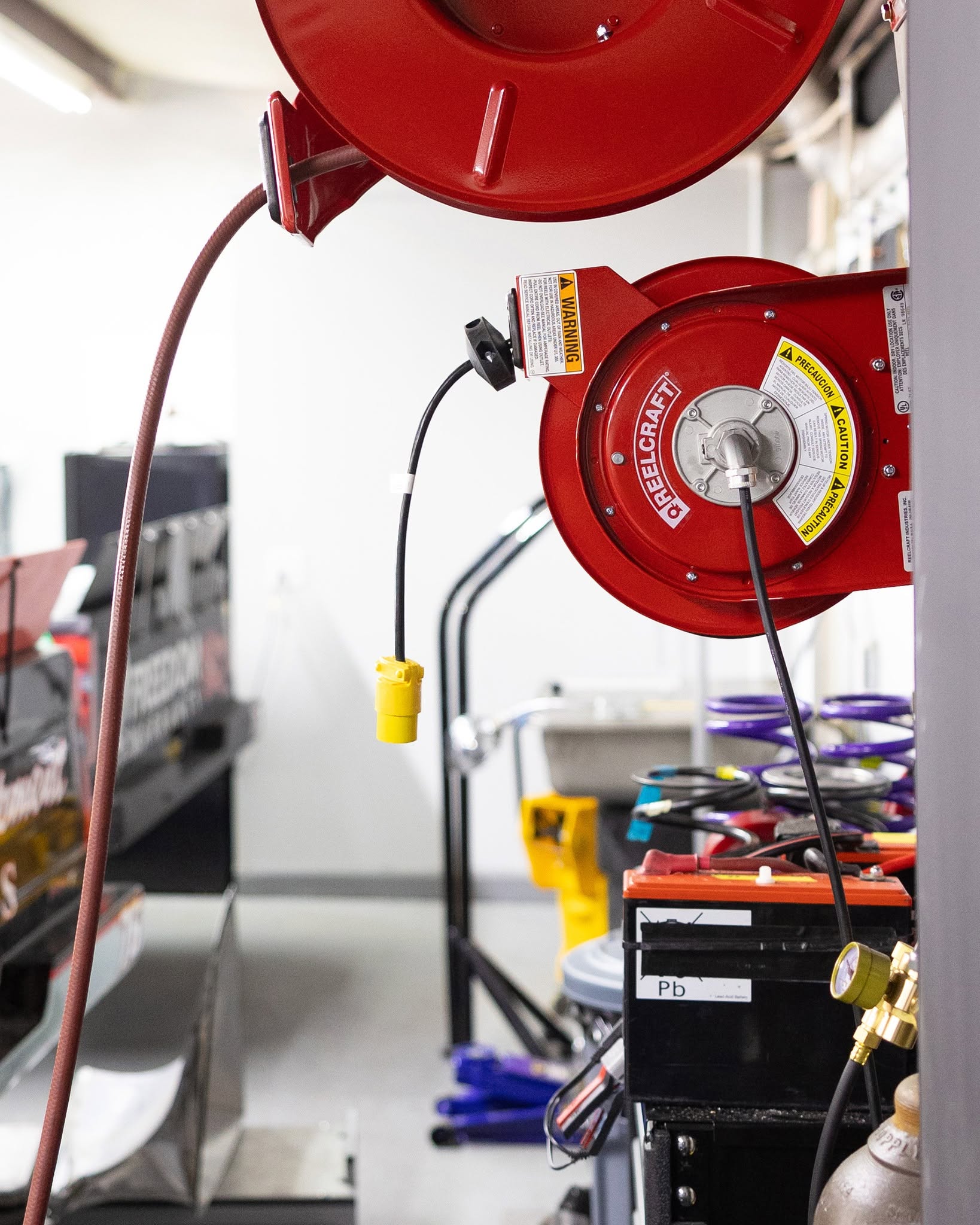
Spring retractable reels add a coil spring mechanism that pulls the hose back automatically when you release it. The spring is the most-replaced component on any reel, and the quality of that spring — how it’s housed, whether it’s enclosed or exposed, how it’s tensioned — has a direct impact on how long the reel lasts and how safely it retracts. Quality manufacturers enclose the spring in a sealed cartridge to protect it from the elements and reduce injury risk during maintenance. Cheaper reels often use exposed springs that corrode and fail earlier.
Motorized reels use an electric motor (typically 12V DC or 120V AC) to drive retraction. They’re the right call when hose length is significant — 100 feet or more — or when the operator is pulling heavy, large-diameter hose repeatedly throughout the day. A well-built motorized reel with a direct-drive motor and low amp draw will hold up in field use; a poorly built one won’t handle the duty cycle.
2. Frame Material: Steel vs. Aluminum
Steel is the dominant material for industrial-grade reels. It handles high pressures, resists deformation, and is easier to repair. A good steel reel from an established U.S. manufacturer is built to last 10–20+ years in a shop or field environment.
Aluminum is lighter and offers better corrosion resistance — a meaningful advantage in spray, chemical, or wash applications where the reel is constantly exposed to water, detergent, or chemical contact. For pressure washers, soft wash contractors, or pest control operators, aluminum is often the better long-term choice despite the slightly higher price.
The frame construction method also matters. Stamped steel components cost less to produce than CNC-machined or rolled edges, and it shows in how the reel handles stress over time.
3. Swivel / Rotary Union Quality
The swivel is where most reels eventually leak. It’s the rotating joint that allows the reel drum to spin while fluid flows through. In cheaper reels, the swivel is often the first thing to go. Quality manufacturers use full-flow, low-stress swivel designs with machined components and proper seals — affecting both longevity and pressure rating.
4. Hose Capacity and Pressure Rating
A reel that handles 3/8″ x 50′ of air hose at 300 PSI is a fundamentally different product than one that handles 1/2″ x 100′ at 3,000 PSI. Larger drums, stronger frames, beefier springs, and higher-rated components all add cost. Don’t buy for your minimum need — spec for the worst day on the job.
5. Application Type
Specialized applications cost more because they require non-standard materials or certifications:
• Grease and oil reels need pressure-rated swivels and hose compatible with petroleum products.
• DEF (diesel exhaust fluid) reels require stainless steel fluid paths to prevent contamination.
• Welding reels must handle twin-line hose and gas-rated components.
• NEMA 4 cord reels require weatherproof enclosures for outdoor or wet environments.
• Chemical reels may require stainless steel or chemically inert internal components depending on what’s flowing through them.
What You Can Expect at Each Price Point
Under $150
Entry-level or import product. Fine for light-duty, low-frequency use in a clean, indoor environment. Don’t expect these to survive five years in a commercial shop or field application.
$150 – $400
Mid-range spring retractable. This is where most basic shop reels for air, water, and oil live. U.S.-made options exist in this range. At the low end, you’re getting a functional reel. At the high end, you’re getting engineered components, better springs, and actual serviceability.
$400 – $900
This is the sweet spot for heavy-duty work in commercial or industrial settings — maintenance shops, OEM skid builds, fleet facilities, agriculture. You’re getting all-steel construction, sealed bearings, containerized springs, and a reel that’s designed to be serviced rather than thrown away.
$600 – $1,500+
Motorized reels and heavy-duty specialty reels. Right for spray trucks, wash skids, large-format industrial applications, and anywhere operators are working with long hose runs or heavy-duty retrieval cycles. The right motorized reel in a high-use application pays for itself in reduced operator fatigue and hose wear alone.
The Midwest Reel Manufacturers Worth Knowing
The industrial hose reel category has a handful of serious U.S.-based manufacturers that have earned their reputations over decades. A few notable names based in the Midwest include Reelcraft Industries (Columbia City, IN — one of the widest product ranges in the industry) and Summit Hose Reel Manufacturing (Indianapolis, IN — focused primarily on pressure washing and spray applications). Outside the Midwest but still well-known: Coxreels (Scottsdale, AZ — known for their patented safety rewind system and CNC-manufactured components) and Hannay Reels (Westerlo, NY — a premium option with a strong custom build capability). Each has different strengths depending on your application.
The Real Cost Question
The price of a hose reel isn’t what you pay on day one. It’s what you pay over three to five years when you factor in downtime, repairs, replacement parts, and hose wear from poor retraction.
A $200 reel that fails in 18 months of daily commercial use cost you more than a $500 reel that runs for a decade. Especially when you factor in the half-day of downtime and the replacement hose that got kinked because the spring gave out on a job site.
Buy for the job you’re actually running, not the job you’re hoping to have.
A Quick Buying Checklist
Before you spec a reel, answer these:
| 1 | What fluid are you running, and at what pressure and flow rate? |
| 2 | What’s your hose length and diameter? |
| 3 | How many times per day will this reel be extended and retracted? |
| 4 | Is corrosion resistance a factor (outdoor, chemical, wash environment)? |
| 5 | Will this be mounted on a mobile unit or a fixed facility? |
| 6 | Do you need the reel to be serviceable in-house, or is replacement acceptable? |
A good manufacturer or distributor can match you to the right reel once you’ve answered those six questions.
Have questions about speccing the right reel for your application? Visit reelcraft.com to find the right fit.
Sources
• Global Industrial — air and water hose reel category listings (globalindustrial.com)
• Hose & Fitting Supply — motorized and spring retractable hose reel listings (hoseandfittingsupply.com)
• Houston Suburb / Power Hose Reel Pricing Guide (houstonsuburb.com, February 2026)
• Coxreels product catalog and company overview (coxreels.com)
• Hannay Reels product range and blog (hannay.com)
• Reelcraft Industries internal product documentation and competitive analysis (2026)